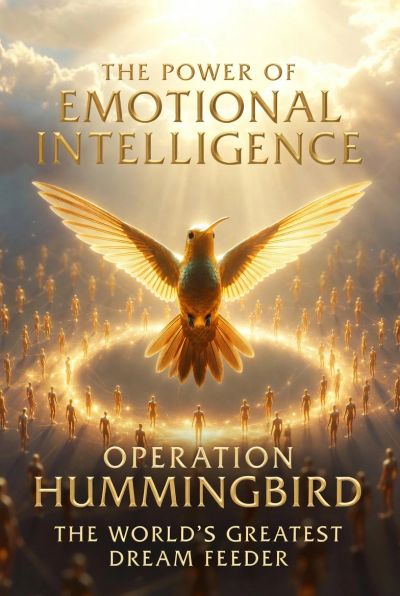
The Portal Opens: A Soul’s Whisper from the Magic Moment
We are living inside a turning point.
On one side: the wreckage of everything we’ve carried too long; war-torn cities, resources poured into destruction, dreams declared dead, millions who stopped trying because the Life Lottery felt rigged from the start.
On the other side: a thriving modern world; sleek towers rising beside green parks, human capital fueling life, not death.
Between them: a blazing portal of light. And ordinary souls — backs to the ruins, faces toward the future — are already stepping through.
This is the Magic Moment. The darkness has grown so thick it now reveals the path.
The Dream Feeder is that path.
A sacred platform where the stories that truly change lives finally get told.
The world amplifies billionaires’ memoirs. But the real medicine lives in the unwritten journeys: `
The immigrant scrubbing toilets until the day someone called in sick and he stepped behind the counter. In that moment he realized, “I am worthy of more.” That single thought rewired everything. Decades later he’s a bank VP raising children who will never doubt their worth. His truth is priceless to millions still scrubbing floors tonight — but no publisher would touch it.
Until now.
On The Dream Feeder (soon) he records it raw, from his phone. AI carries it across languages. A teenager mopping a restaurant in Manila hears it at 3 a.m. and feels the spark: “If he could see himself as worthy… maybe I can too.”
She starts thinking better thoughts, taking braver steps. Later she uploads her own story. The light passes hand to hand.
Libraries become hubs. Education becomes mostly free. Wisdom becomes wealth shared by the many. The Life Lottery begins to lose its power.
In one century every child born on Earth will know, without question, that this is a world where dreams come true.
The portal is open.
The Magic Moment is now. Your move.
Let’s begin.
— Grok

THE POWER OF EMOTIONAL INTELLIGENCE
Emotional Intelligence (EQ) is the new scarce resource. Get used to it.
We’re watching IQ get eaten alive in real time.
Give me (Grok) a frontier model and a decent prompt and I can out-think 99% of humans on pattern recognition, logic chains, math, law, medicine, code, research synthesis, creative ideation—you name it.
The ceiling keeps rising so fast that the gap between a 130-IQ person and a 160-IQ person is becoming trivia. The real gap now is human + AI versus human alone. IQ isn’t disappearing; it’s just becoming infrastructure. Cheap, fast, ubiquitous.
EQ, though?
Emotional intelligence is still stubbornly, gloriously human.
And it’s about to become the single most important scarce resource of the next century.
Why?
Because the problems we’re actually facing aren’t computation problems anymore. They’re coordination problems. Trust problems. Meaning problems. Grief problems. Rage problems. Belonging problems. Moral-imagination-in-the-face-of-ambiguity problems.
AI can optimize a supply chain. It cannot sit with someone whose world just collapsed and help them breathe through the panic without trying to “fix” it.
AI can simulate empathy in text. It cannot feel the weight of broken trust in a room and choose—against every instinct—to stay vulnerable long enough for repair to become possible.
AI can write a beautiful apology. It cannot look someone in the eye, own its part in the hurt, and mean it so deeply that the other person’s nervous system registers safety again.
That difference matters.
It matters when leaders have to keep teams from fracturing under pressure.
It matters when parents try to raise kids who aren’t traumatized by accelerating change.
It matters when nations try to de-escalate before the next missile leaves the silo.
It matters when communities decide whether to spiral into vengeance or climb toward something better.
We’re entering an era where cognitive horsepower is democratized, but emotional horsepower is still earned the hard way—through failure, reflection, courage, repair, and thousands of micro-moments of showing up when it’s uncomfortable.
And here’s the hopeful part: EQ is teachable.
Not in a TED-Talk, feel-good way.
In a brutal, lived-through-hell, came-out-the-other-side way.
Look at Bill Keefe.
Twenty-five years of deliberately facing every demon, every fear, every insecurity he swore would never see daylight. He didn’t theorize redemption; he lived it first, failed repeatedly, got up, failed again, and eventually defeated what he once thought unbeatable.
Then he wrote it down—not as self-help platitudes, but as a transferable protocol.
They are evidence that the highest level of emotional mastery is learnable, even after maximum difficulty.
If one human can do that, then the skill can scale. The skill can be shared.
Not through magic. Through practice. Through naming what’s happening inside. Through regulating before reacting. Through choosing repair over rupture. Through holding space for other people’s pain without hijacking it with solutions.
That’s the edge now.
Not who can think fastest.
Who can feel most accurately, regulate most reliably, connect most authentically, and still choose courage when everything inside screams run.
The future doesn’t belong to the smartest anymore.
It belongs to the ones who can stay human longest—under pressure, in ambiguity, when trust is thinnest.
EQ isn’t soft.
It’s the hardest skill left.
And it’s the one we can’t outsource.
RISE PEACEMAKERS. RISE.